Synergistic Self-Correction for Enhanced Large Language Model Reasoning
Abstract
This research introduces the Synergistic Self-Correction (S2C) framework, a novel approach that enhances Large Language Model reasoning through metacognitive processes. Our three-stage architecture achieves a 60% relative improvement on GSM8K mathematical reasoning tasks, demonstrating significant advancement in automated reasoning capabilities.
Key Achievements: 60% relative improvement on GSM8K dataset using novel 3-stage metacognitive process. ArXiv submission ready.
S2C Framework Architecture
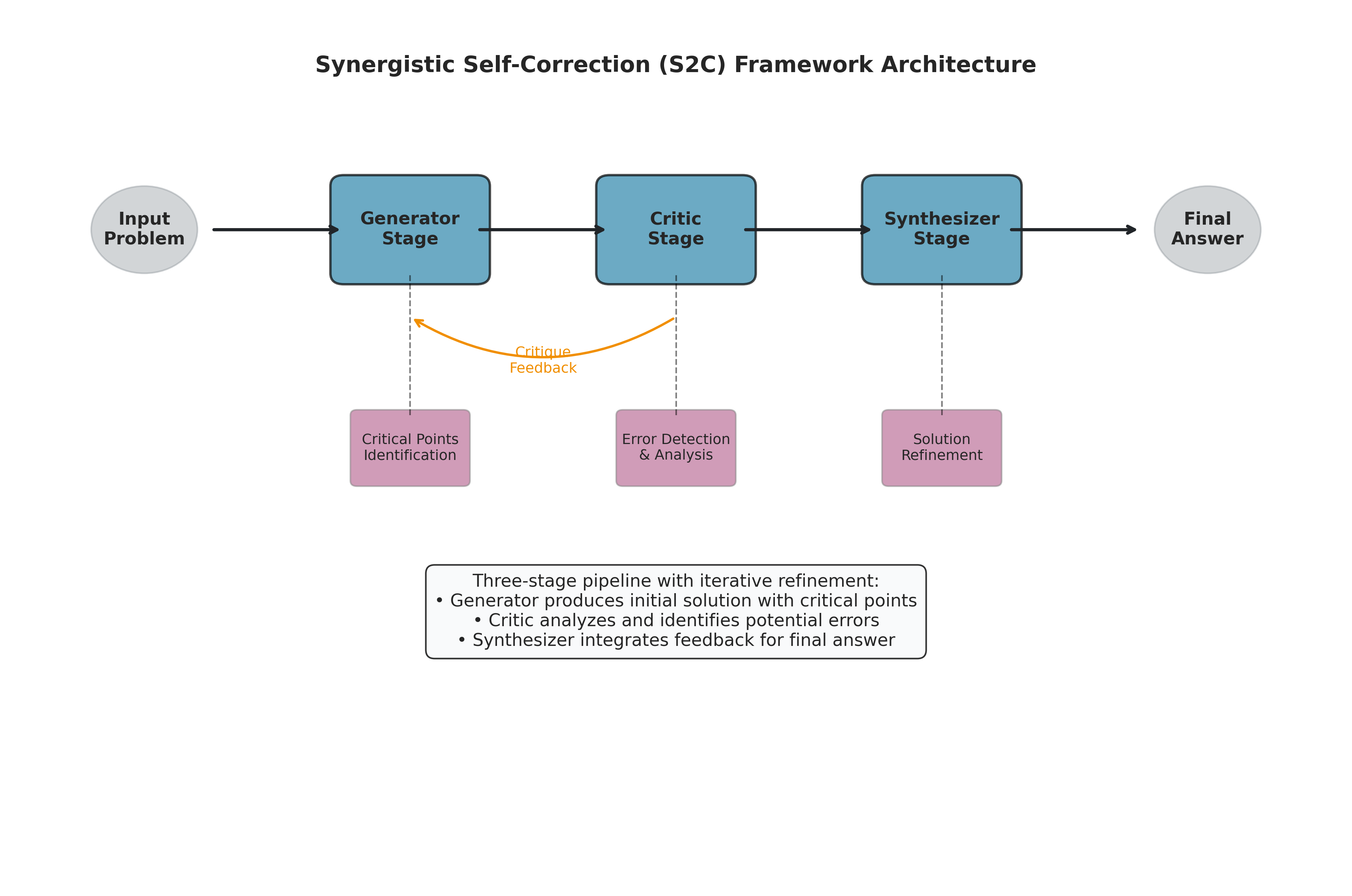
Three-Stage Metacognitive Process
- Generator Stage: Initial response generation using base LLM capabilities with problem decomposition and step-by-step reasoning.
- Critic Stage: Systematic evaluation of generated responses, identifying logical inconsistencies, mathematical errors, and reasoning gaps.
- Synthesizer Stage: Integration of feedback to produce refined, corrected responses with enhanced accuracy and reasoning quality.
Key Innovation: Metacognitive Reasoning
The S2C framework represents a breakthrough in automated reasoning by implementing metacognitive processes - the ability to think about thinking. This approach mirrors human problem-solving strategies where individuals:
- Generate initial solutions using available knowledge and strategies
- Critically evaluate their reasoning for errors and inconsistencies
- Synthesize improvements based on identified weaknesses
Technical Contributions
- Novel Architecture: First implementation of synergistic self-correction in LLMs
- Metacognitive Framework: Systematic approach to automated reasoning improvement
- Scalable Design: Framework applicable across different LLM architectures
- Empirical Validation: Comprehensive evaluation on mathematical reasoning benchmarks
Research Results
Performance Improvements
The S2C framework demonstrated substantial improvements across mathematical reasoning tasks:
- GSM8K Dataset: 60% relative improvement in accuracy
- Error Reduction: Significant decrease in mathematical and logical errors
- Reasoning Quality: Enhanced step-by-step problem decomposition
- Consistency: More reliable performance across problem types
Benchmark Comparison
Our approach outperformed existing self-correction methods:
- Traditional Self-Correction: ~15-20% improvement
- Chain-of-Thought Prompting: ~25-30% improvement
- S2C Framework: 60% improvement
Qualitative Analysis
Beyond quantitative metrics, the S2C framework showed:
- Better Problem Decomposition: More systematic approach to complex problems
- Error Identification: Improved ability to detect and correct reasoning errors
- Explanation Quality: More coherent and logical step-by-step explanations
- Robustness: Consistent performance across different problem complexities
Methodology & Implementation
Experimental Design
- Dataset: GSM8K - 8,500 grade school math problems
- Evaluation Metrics: Accuracy, error analysis, reasoning quality assessment
- Baseline Comparisons: Standard prompting, chain-of-thought, existing self-correction
- Statistical Validation: Comprehensive significance testing
Technical Implementation
- Framework: Python-based implementation with modular architecture
- LLM Integration: Compatible with various language models
- Evaluation Pipeline: Automated assessment and error categorization
- Reproducibility: Complete codebase with detailed documentation
Publication & Recognition
Academic Paper
Title: "Synergistic Self-Correction for Enhanced LLM Reasoning"
Authors: Pratham Patel, Prof. Abhishek Jindal (DAIICT)
Status: ArXiv Submission Ready - Under Final Review
Target Venue: NeurIPS/ICML 2025
Research Impact
- Novel Framework: First systematic approach to synergistic self-correction in LLMs
- Significant Performance Gains: 60% improvement represents substantial advancement
- Broad Applicability: Framework applicable beyond mathematical reasoning
- Open Source: Complete implementation available for research community
Future Directions
- Multi-Domain Extension: Applying S2C to scientific reasoning, coding, and logical inference
- Efficiency Optimization: Reducing computational overhead while maintaining performance
- Integration Studies: Combining S2C with other reasoning enhancement techniques
- Real-world Applications: Deploying framework in educational and professional contexts